Rugby Everest
THE SOLO PLAYER'S GUIDE
Get the guide
THE SOLO PLAYER'S GUIDE, ON YOUR PHONE

15 things to practise on your own.

A guide that opens on your phone, with a drill in every chapter and one number to count in your next match.
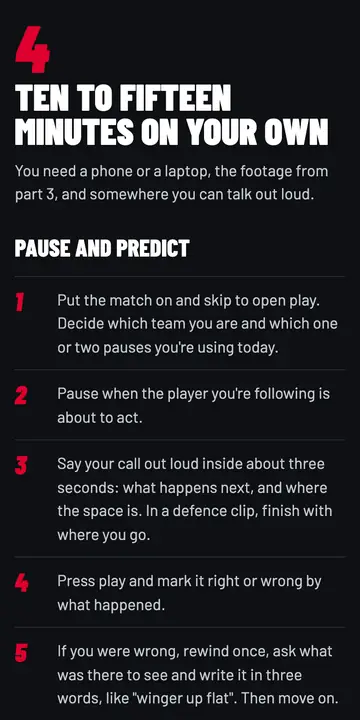
The drill in chapter 7 on a phone: Ten to fifteen minutes on your own. Pause and predict, in numbered steps, starting with putting the match on and skipping to open play.
A DRILL, CHAPTER 7

You pay once, and it's sent to your email as soon as you've paid.

WHAT YOU GET

Everything in it, counted.

I counted these from the guide itself. The drills and the cards come first, because I think they're the parts you'll use most, and the pictures below are real pages as they open on a phone.

16
Drills you do on your own

There's one in every chapter and two in chapter 9. Each one says what you need and how you'd know it's working, and most of them take ten to fifteen minutes with a ball or your phone.

15
Numbers to count in your next match

Every chapter ends with one thing to count in a match and write down in the changing room, like how many times you'd looked at the defence before the pass came to you. It's how you find out for yourself whether the drill is doing anything.

18
Cards and logs on your phone

Twelve of the chapters have at least one on the page. What you type stays on the phone you're using, with no account, so you can pick it up where you left it.
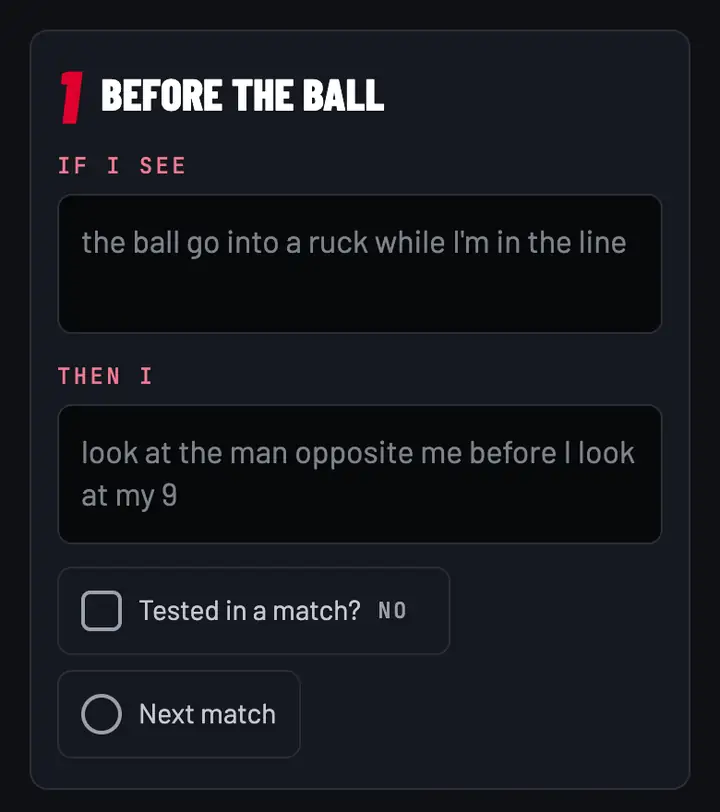
The card My three plans from chapter 8, with a box for If I see and a box for Then I, the guide's own example lines in grey, a tick for Tested in a match and a button for Next match.
MY THREE PLANS, CHAPTER 8
10
Weeks of plan

Chapter 15 is about picking one or two drills and fitting them round training and a match. Then you tick off your sessions on the tracker for ten weeks, and rate how automatic they felt.
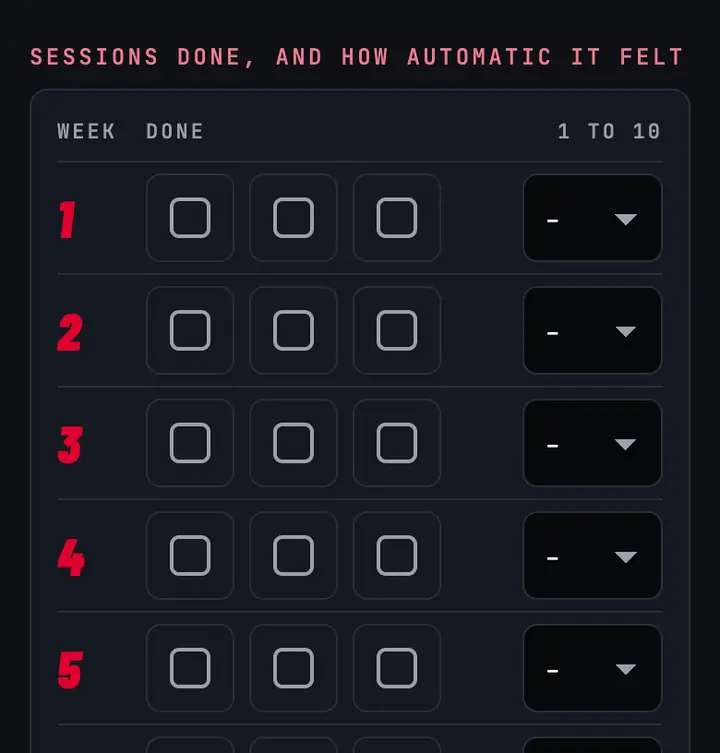
The tracker My ten weeks from chapter 15: one row a week, three boxes to tick for sessions done, and a 1 to 10 rating for how automatic it felt.
MY TEN WEEKS, CHAPTER 15
51
Pitch diagrams

Match situations drawn from above, in every chapter except the last one, each followed by what you'd do about it.
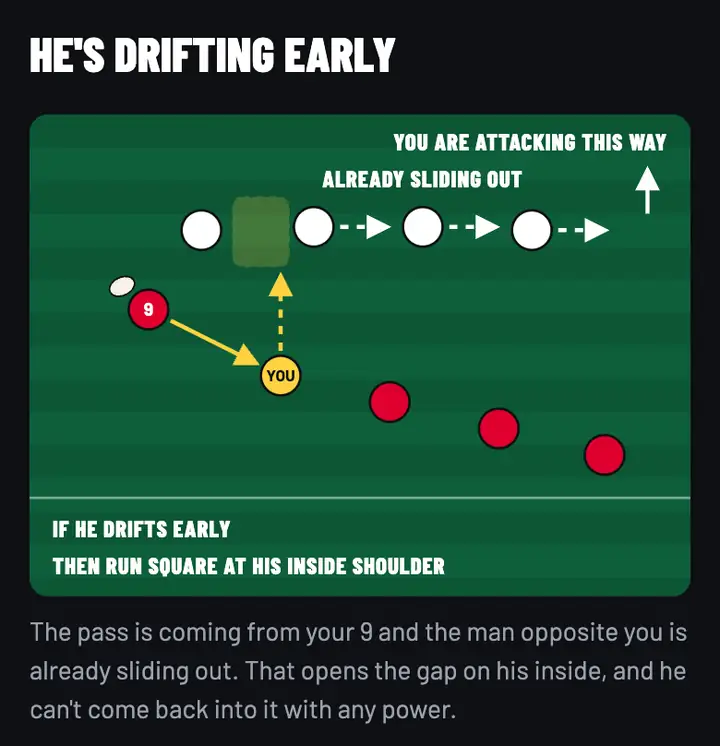
Pitch diagram from chapter 8, He's drifting early: the man opposite you slides out as the pass comes from your 9, and if he drifts early you run square at his inside shoulder.
HE'S DRIFTING EARLY, CHAPTER 8
15
Short chapters, in four parts

The parts are called your head, your eyes, the other 79 minutes and running it yourself. A chapter takes about fifteen minutes to read, so the whole guide is about four hours.
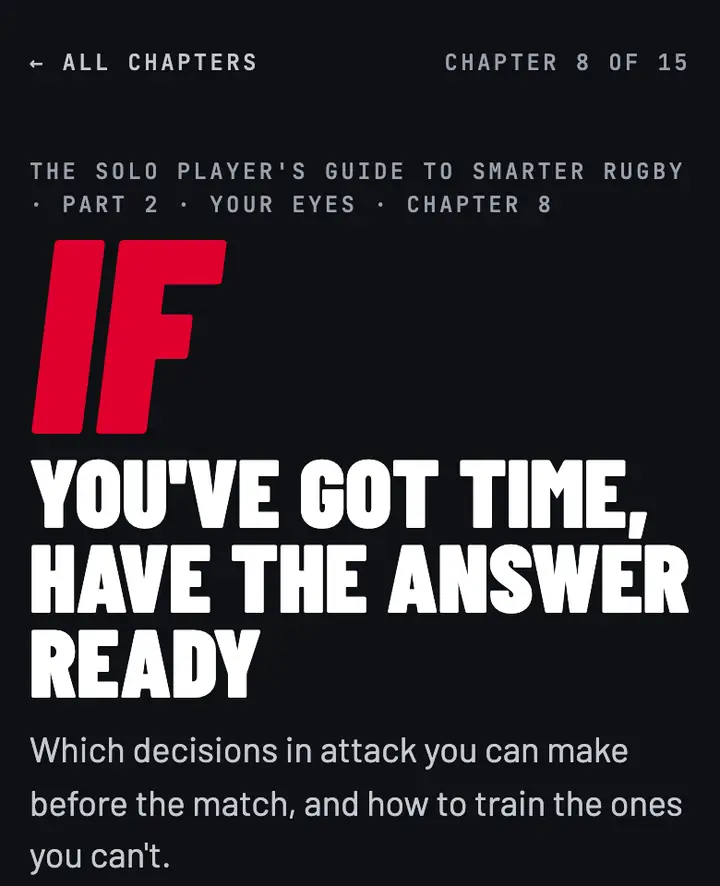
The opening of chapter 8 on a phone: If you've got time, have the answer ready. Which decisions in attack you can make before the match, and how to train the ones you can't.
CHAPTER 8, AS IT OPENS
182
Sources, and what they don't show

Each chapter has a plain section on the research behind it, which says who the studies were done on and where nobody has tested something yet.

6
Position packs

Scrum-half, fly-half, both centres, wing and fullback, the full packs that are also sold on their own. Between them there are 211 reads, each one what you see and what you do, and 62 more pitch diagrams.

+
The Goal Kicking Tracker

You tap where you kicked from, log it over or missed, and it shows your percentage and points for the last 30 days and the season, saved on your phone with no account.

If you'd rather read some of it first, chapters 5 and 8 are free in full, after a few quick questions and your email. Read two chapters free

WHAT PLAYERS ASK ME

Where I'd start, for what you asked.

Deciding under pressure

Chapters 7 and 8. You pause a match clip, call what happens next out loud and score yourself out of 20, which takes ten to fifteen minutes. I think it's one of the better-tested drills in the guide.

Getting picked

I can't promise that to anybody. Chapter 11 is about the work off the ball that coaches say they look for, and it gives you something to count in your next match, which is how often you were back on your feet before the ball was played again.

Being new to a position

I'd start with the pack for your position, which goes through the job in six parts, and then chapter 11 for where to be when the ball isn't coming to you.

Kicking

Chapter 6 has a ladder of twelve-ball sets with something riding on each one, and chapter 14 has a square of cones to kick at, so every kick out of hand lands in or out. The Goal Kicking Tracker is for your kicks at goal.

Getting more of the ball

Chapter 11 has a drill where you follow one player without the ball and call what they should do next, which takes about ten minutes for 20 calls. The wing pack has you count your touches, and it puts a fair floor at about eight in a full match.

THE PRICE

$47, once.

That gets you everything in the guide, and nothing in it is held back to sell you later. All fifteen chapters, every drill, every card and log, and all six position packs come with the one payment.

What it isn't
A fitness programme
There's no running or lifting plan in it, and nothing on food or weight. The guide says those belong with a qualified coach or a doctor.
A replacement for playing
Work you do alone adds to your rugby. The chapters on reading the game say it's mostly built by playing, and two of them ask you to find a game with real opponents every week.
Something that reads the game for you
You still have to do the looking, in a match, at match speed. The guide can only show you what to look for.
A promise
Getting picked is your goal and I can't promise it. Each chapter says how good its bet probably is and gives you a number to check it by.
COMES WITH THE GUIDE
All six position packs are included
The guide is for any position. Each pack takes one position and goes through the job in detail, with what to look at and what to do when you see it. They're the full packs, the same ones sold on their own, and their links arrive in the same email as the guide.
Scrum-halfFly-halfInside centreOutside centreWingFullback
WHERE THE EVIDENCE IS THIN

The guide tells you when nobody has tested something.

Most of what I've seen written for players promises a result. This guide leans on 182 sources, most of them published studies. A lot of those are small or were done in another sport, and for many I only had the published summary. So each chapter says how far I'd trust it, and these four lines are from the guide.

Where the evidence is better it says that too. Stopping a match clip just before something happens and calling it out loud is one of the better-tested drills in there, and it's the one I'd start with if you can't choose.

CHAPTER 1 · THE UNSEEN GAME
Nobody has tested this drill as I've written it, so I can't tell you it works.
CHAPTER 9 · THE MAN IN FRONT OF YOU
It was tested on screens and in virtual reality and never on grass, so you'll probably get fooled a bit less often, and you'll still get fooled.
CHAPTER 11 · WHEN YOU DON'T HAVE THE BALL
No study in rugby union shows that doing these gets you picked, and nobody has tested whether practising them alone carries into a match.
CHAPTER 12 · TIRED LEGS, CLEAR HEAD
For something sold so confidently online, tired-decision training has the thinnest evidence in this chapter.
THE FIFTEEN CHAPTERS

Four parts, fifteen chapters.

The line under each title is the chapter's own. It's the one instruction the chapter comes down to.
PART 1 · CHAPTERS 1 TO 6
Your head
1
The unseen game
If you saw it and didn't go, try it at training and write down that you did.
2
Confidence follows doing
Do it first and write down what happened, and the feeling usually follows.
3
What you say to yourself
Pick two or three words for the action you want, and say them at the same moment on every rep.
4
The sentences you treat as facts
Count it before you call it a fact.
5
The reset
After a mistake, say your next job and go and do it.
6
Pressure
Do it in the same order every time, and practise it with something riding on it.
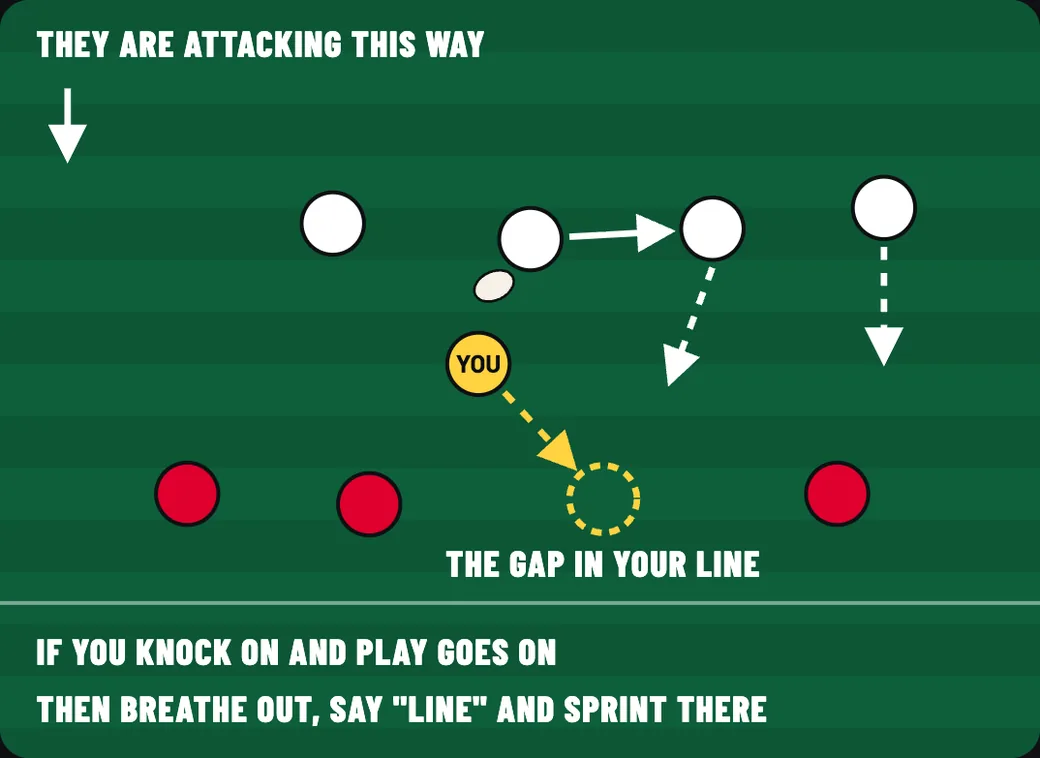
Pitch diagram from chapter 5. You have knocked on, their player has picked the ball up and passed it wide, and you sprint back to the gap in your line.
FROM CHAPTER 5You've knocked on, their man has picked it up and passed, and the teammates who were behind you are now a defensive line with a hole in it. Their runner is a second or two away from it.
PART 2 · CHAPTERS 7 TO 10
Your eyes
7
Reading the game on your own
Pause it, call what happens next out loud, then play it and see.
8
If you've got time, have the answer ready
Plan the moments that give you time, and train your eyes for the ones that don't.
9
The man in front of you
Watch his hips, and let him move first.
10
The whole picture
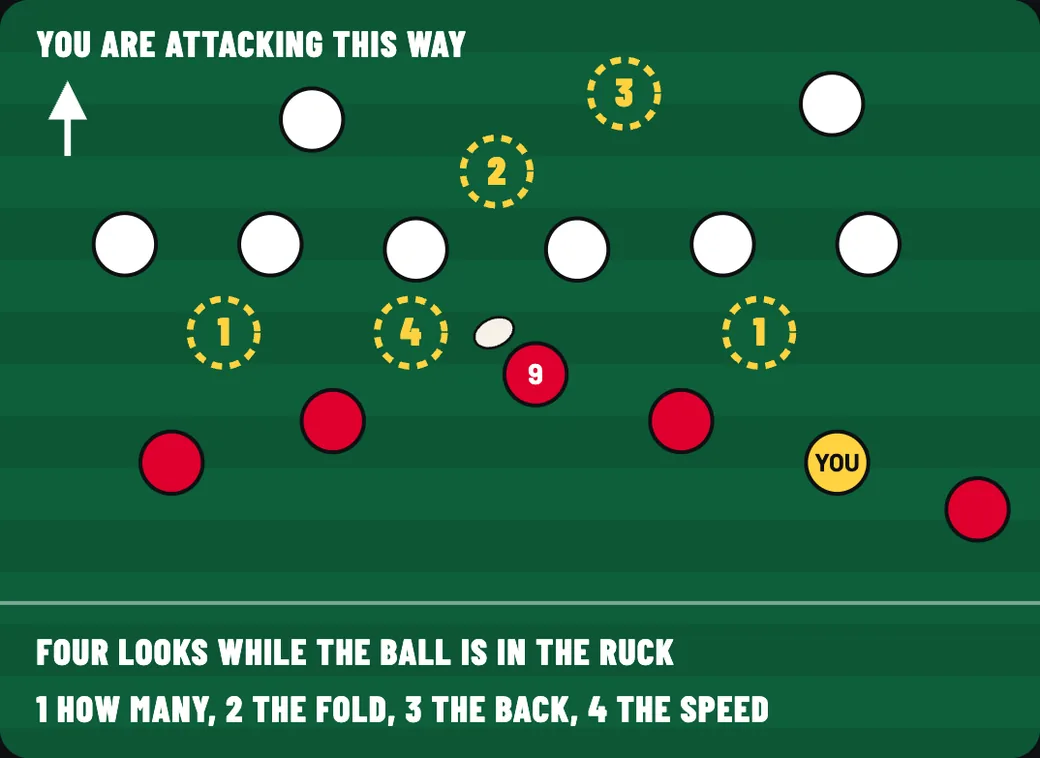
While the ball's in the ruck, look at them: how many, who's folded, who's back, quick or slow.
Pitch diagram from chapter 10. Your ruck in midfield with the four places to look marked: each side of the ruck, their defenders nearest it, their backfield and the ruck itself.
FROM CHAPTER 10Your ruck in midfield, before the ball is out. 1: count them and count you, on each side of the ruck. 2: their two or three nearest the ruck, and whether they've come round from the last one. 3: how many are at the back, and on which side. 4: the ruck itself, and how long the ball has been in it.
PART 3 · CHAPTERS 11 TO 13
The other 79 minutes
11
When you don't have the ball
Be at your next job before the ball is played, and say what you see on the way.
12
Tired legs, clear head
Late on, get your head up and do the plain thing well, because your hands usually go before your head does.
13
What you show, and the referee
After a mistake, head level and on to your next job, and leave the referee to your captain.
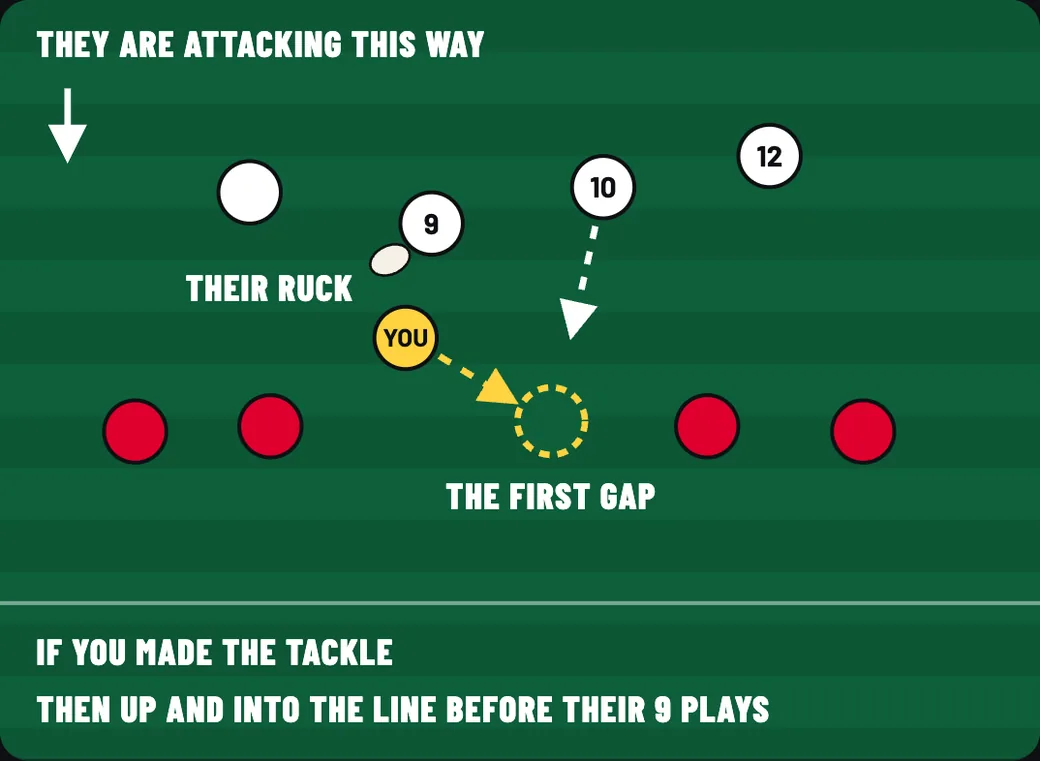
Pitch diagram from chapter 11. You have made a tackle and are on the ground on your side of their ruck, and you get up and run to the gap in your line beside it.
FROM CHAPTER 11They have the ball, so they're attacking down the page at you. You made the tackle and you're on the ground on your own side of the ruck. Their 9 is about to play, and there's a gap in your line beside the ruck that their 10 can see.
PART 4 · CHAPTERS 14 AND 15
Running it yourself
14
Practising when nobody's watching
Give every rep a target, and write the score down.
15
Your week and your ten weeks
Pick one drill, give it a place in your week, and look at its number every week.
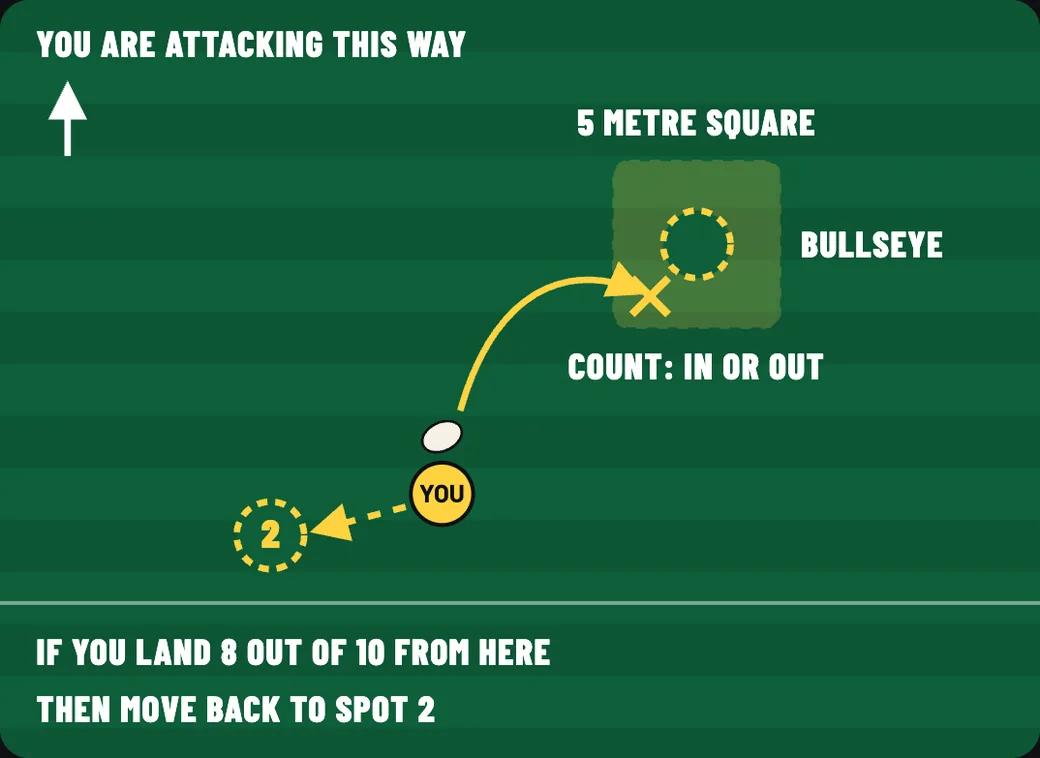
Pitch diagram from chapter 14. You are alone on the pitch, kicking out of hand at a square of cones with one cone in the middle, and a second spot is marked behind you.
FROM CHAPTER 14You're in yellow with nobody else on the pitch, kicking up the page at a square of cones. Every kick lands in or out, so every rep gets an answer, and the cone in the middle is a target inside the target. Spot 2 is for when this gets easy.
QUESTIONS

Before you buy

Is everything included when I pay?
Yes. The one payment gets you all fifteen chapters, every drill, all 18 cards and logs, and all six position packs. Nothing in the guide is locked or kept back to sell you later.
Which positions is it for?
Any position. The reads and drills aren't tied to one, and the chapter that leans most on kicking says what to do if you never kick. The six packs that come with it are for scrum-half, fly-half, inside centre, outside centre, wing and fullback.
What level is it written for?
Club and school players who want to move up a level. The pros are in there as players to watch, with what to look at when you watch them.
Do I need a team or a coach?
No. Every drill can be done alone. A few things can only be tried against real defenders, and the guide says which, so a game of touch now and then helps.
How much time does it take?
The guide asks for two or three sessions a week of ten to fifteen minutes, on top of training and matches and never in place of them. The last chapter is about picking one drill at a time, because nobody could do all of them.
Can I read some of it first?
Yes. Chapters 5 and 8 are free to read in full, after a few quick questions and your email, and you can read two chapters free here. Anything you type into their cards should still be there when you open the guide on the same phone.
Is it a subscription?
No. You pay $47 once and you keep all of it.
How do I get it?
By email, straight after you pay. The email has your own link to the guide and the links to the six packs. They open on your phone and you don't need an account. If you lose the email, you can have the links sent again from the bottom of this page.

I've already bought a position pack.
Then what you paid for it comes off the price of the guide. That's done through a private link sent to the email you bought with, and when you open this page from that link your own price is at the top.
I'm a parent or a coach, is it for me?
It's written to the player, and you can read it for one. If the player is under 18, the guide asks them in several places to show a parent or a coach what they've written.
Start with one drill.
The last chapter says to pick one and give it a place in your week. The guide is $47, and that gets you everything in it, the six position packs included.
Rugby Everest. Rugby for the players who want to understand it.rugbyeverest.app/solo-guide